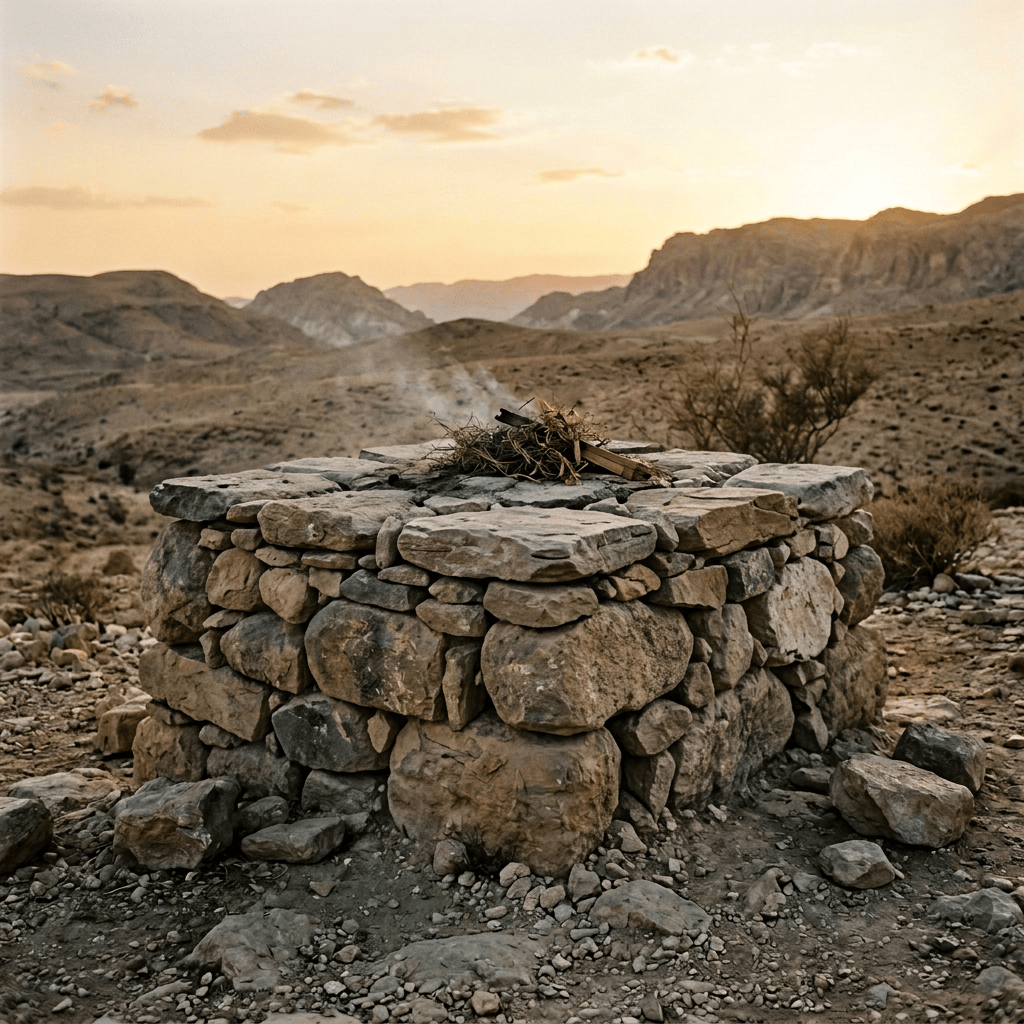
Exodus 20:25 “If you make me an altar of stone, you shall not build it of hewn stones, for if you wield your tool on it you profane it.”
1 Kings 6:7 “When the house was built, it was with stone prepared at the quarry, so that neither hammer nor axe nor any tool of iron was heard in the house while it was being built.”
It is important to pay close attention to the contrasts in Scripture, for they are given to us for a purpose. An example of this is given in the verses above. In the first case, Moses was instructed by God that when an altar was made upon which to offer sacrifices to Him, that altar was to be made of natural stone. If anyone used hewn stones, it would profane the altar. We see a shadow in this Old Testament altar of a reality that is revealed for us in the New Testament. We read in Hebrews 13:10-13 that “We have an altar from which those who serve the tent have no right to eat. For the bodies of those animals whose blood is brought into the holy places by the high priest as a sacrifice for sin are burned outside the camp. So Jesus also suffered outside the gate in order to sanctify the people through his own blood. Therefore let us go to him outside the camp and bear the reproach he endured.” And so we see that this New Testament place of sacrifice, this altar, is pointing to the cross, the place where Jesus suffered and died for us. It was His sacrifice that made a way for us to be forgiven. And that sacrifice was wholly a work of God. It wasn’t something dreamed up by man. It wasn’t a work of man. And so any effort to add to this sacrifice with our own efforts doesn’t really add anything to it. Rather it profanes it. “For by grace you have been saved through faith. And this is not your own doing; it is the gift of God, not a result of works, so that no one may boast” (Ephesians 2:8-9).
Which brings us to a great contrast. While the Old Testament altar was to be made of uncut stones, the stones used in the foundation of Solomon’s temple were made of hewn stones, but the work that prepared those stones was all done offsite – at the quarry. Why should cut stones be used in this place of worship to God while only uncut stones were to be used in construction of an altar? Why could a hammer, axe, or other tools of iron be used on the stone at this quarry, but not after the stone was taken to the site on which the temple was built?
Again, our thoughts turn to Christ, whom the Scriptures tell us is the cornerstone on which the spiritual temple of God is being built (Ephesians 2:20). Solomon’s temple pointed to Christ, both in its construction, its furnishings, its ceremonies, and its sacrifices. Ultimately, it all pointed to the cross.
So let’s think about the crucifixion more deeply. Remember that Jesus suffered on the cross at a place called Golgotha. We are told that it was outside the city gates of Jerusalem (John 19:17-20). It was most likely the place of a quarry where limestone was mined. And it was at this place outside the city that an ax would have been used to cut down the tree and fashion the cross on which Jesus died. We know that a hammer was used to drive in the iron spikes with which the Roman soldiers nailed Jesus to it. What parallels with the temple account! It was all done by man, in one sense, but it was all the plan of God and His divine work on the other hand.
But then the work was finished. Christ will never be crucified again. And those who, in effect, attempt to do so, will in fact be destroyed themselves (Hebrews 6:6). As Jesus warned those who were plotting to kill Him, “What then is this that is written: ‘The stone that the builders rejected has become the cornerstone?’ Everyone who falls on that stone will be broken to pieces, and when it falls on anyone, it will crush him” (Luke 20:17-18). And then we are told that “the scribes and the chief priests sought to lay hands on him at that very hour, for they perceived that he had told this parable against them, but they feared the people.”
No one will use any ax, hammer, or nails again against the Son of Man. No, now He reigns in glory. So what will you and I do in response to this? All the work has been done for us. All that is necessary was finished on the cross. And so now, “if you confess with your mouth that Jesus is Lord and believe in your heart that God raised him from the dead, you will be saved. For with the heart one believes and is justified, and with the mouth one confesses and is saved” (Romans 10:9-10).
What is your response to this wonderful work of God?


Leave a Reply