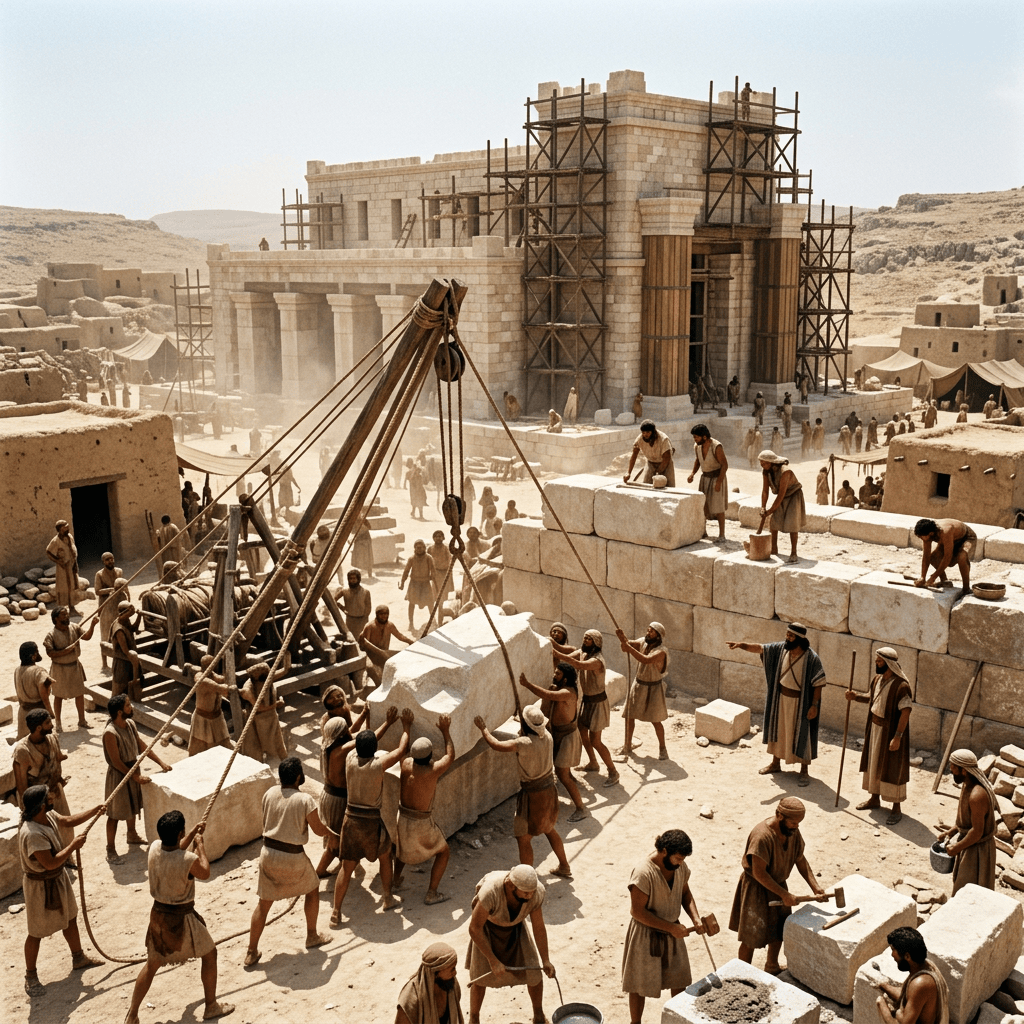
1 Kings 5:13 “King Solomon drafted forced labor out of all Israel.”
In the passage above, we are told that King Solomon used forced labor to build the temple. Typically, such conscripts were taken from the surrounding nations that had been defeated in battle. Earlier examples of this can be found in places such as Judges 1:28, which says, “When Israel grew strong, they put the Canaanites to forced labor, but did not drive them out completely.” And then under king David we are told that “Adoram was in charge of the forced labor” (2 Samuel 20:24).
Over the last few days, I’ve been pondering this and praying about how this might relate to us? Christians, too, serve a king, the King of kings. Is there a sense in which this King, too, conscripts forced laborers into His service? Doesn’t the Bible tell us that Jesus “gave himself for us to redeem us from all lawlessness and to purify for himself a people for his own possession who are zealous for good works” (Titus 2:14)? And as to serving the Lord by means of giving, haven’t we been told that “Each one must give as he has decided in his heart, not reluctantly or under compulsion, for God loves a cheerful giver” (2 Corinthians 9:6-7)? So, if the thing that glorifies God is to serve Him willingly, where does all this talk of forced labor fit in? Does it have any place?
Which brings us to the topic of the enemies of God, i.e., those of whom Jesus spoke that hated Him and had the attitude of “We do not want this man to reign over us” (Luke 19:14). What about those people and what about the many angels who might, at best, ignore His kingship, and at worst, actively oppose it in every way they can? Are they free to do so? Can they somehow subvert the will of God? Are they free of His sovereignty? Well, to answer this we need look no further than the rest of the account from the previously referenced Luke 19. As Jesus went on in this parable which spoke of those who don’t want Him to become king, Jesus tells us that, nevertheless, the nobleman of whom they spoke these words received His kingdom and returned. They didn’t like it, they railed against it, but it didn’t matter, for the King would be King no matter what anyone thought.
I like to think of this in terms of a Plan A and a Plan B. Plan A refers to those who willingly serve King Jesus. They are those who recognize His unparalleled glory and goodness and want more than ever to submit to His will. These are those who love Him and obey Him. They are the true sons and daughters of God. But then there is a Plan B. This plan applies to those who have ignored Him, rejected Him, turned away from Him, and want nothing to do with Him. But the reality is that when anyone has such an attitude against the King of kings, it’s a losing battle. They are no match for Him, and in the end, they will still serve Him, though that service will be despite their opposition to Him. In that sense it parallels the forced labor of King Solomon’s reign.
So are there any examples of this? There are many! One example is in the story of Joseph. Here was one who was hated by his brothers, sold into slavery, and counted as dead. Here was one who was lied about, thrown into prison as a result, and who languished there for years. However, in the sovereignty of God, Joseph was eventually released from prison and ascended to a position of great authority in Egypt. Joseph’s attitude when his evil brothers found themselves at the mercy of their (now) royal brother is expressed in the following words: “you meant evil against me, but God meant it for good, to bring it about that many people should be kept alive, as they are today” (Genesis 50:20). And so, in their wickedness, these brothers were unwittingly serving God – not because they wanted to, but because God was in sovereign control.
Then we have the account of the wicked Assyrians whom God raised up in judgement against Israel because of their sin. Listen to how God describes them in Isaiah’s prophecy in Isaiah 10: “Assyria, the rod of my anger; the staff in their hands is my fury! Against a godless nation I send him, and against the people of my wrath I command him.” But then God says this: “But he does not so intend, and his heart does not so think; but it is in his heart to destroy, and to cut off nations not a few.” And then God pronounces this judgment on Assyria, a nation which, unwittingly, was nothing more than a pawn in His hands: “Shall the axe boast over him who hews with it, or the saw magnify itself against him who wields it? As if a rod should wield him who lifts it, or as if a staff should lift him who is not wood! Therefore the Lord God of hosts will send wasting sickness among his stout warriors, and under his glory a burning will be kindled, like the burning of fire. The light of Israel will become a fire, and his Holy One a flame, and it will burn and devour his thorns and briers in one day.”
Of course, the account of Job is another example. Here was Satan, the adversary of God, focused wholeheartedly on the destruction of Job. But in this entire account, God ultimately set the rules. Satan could in no way circumvent God’s sovereignty. And in the end, the account of Job has provided comfort and strength to many others who have, likewise, been touched by the attacks of the enemy of our souls.
Then from the New Testament, we remember the following words from Jesus to Peter: “Simon, Simon, behold, Satan demanded (this word also means “asked”) to have you, that he might sift you like wheat, but I have prayed for you that your faith may not fail. And when you have turned again, strengthen your brothers” (Luke 22:31-32). So, who did Satan ask when he asked to “sift Peter like wheat”? It was obviously the only One with sovereign authority over Him, the King of kings. You see, although it may be very difficult to understand, what Satan meant for Peter’s destruction was turned to provide strength for Peter’s brothers. And that includes you and me, who, like Peter, have fallen into sin against our Lord from time to time, but like Peter, have also found forgiveness from this One who forgives seventy-times seven.
And from Paul’s life we have the account of his “thorn in the flesh” from 2 Corinthians 12. Paul further identified this thorn as “a messenger of Satan to harass me.” Yet, we are told that this messenger HAD BEEN GIVEN TO HIM to keep him from becoming conceited because of the incredible spiritual experiences God had given him. But who gave Him this “messenger”? Obviously, it was God Himself. And so God used this messenger who hated Him in a manner that brought glory to Himself, nevertheless. As such, this messenger was conscripted into a kind of “forced labor,” doing the will of God in spite of the desires of his heart which were the opposite of willing service to the King.
Finally, we have the account of the crucifixion of the Son of God. In Peter’s sermon on the day of Pentecost he preached the following words to the Jews: “Men of Israel, hear these words: Jesus of Nazareth, a man attested to you by God with mighty works and wonders and signs that God did through him in your midst, as you yourselves know—this Jesus, delivered up according to the definite plan and foreknowledge of God, you crucified and killed by the hands of lawless men” (Acts 2:22-23). And then we have this prayer by the persecuted church in Jerusalem: “Why did the Gentiles rage, and the peoples plot in vain? The kings of the earth set themselves, and the rulers were gathered together, against the Lord and against his Anointed’— for truly in this city there were gathered together against your holy servant Jesus, whom you anointed, both Herod and Pontius Pilate, along with the Gentiles and the peoples of Israel, to do whatever your hand and your plan had predestined to take place.” It’s just as the wicked Balaam said in his attempts to curse Israel at the request of wicked Balak, “‘If Balak should give me his house full of silver and gold, I would not be able to go beyond the word of the Lord, to do either good or bad of my own will. What the Lord speaks, that will I speak” (Numbers 24:13). In all of this we see these wicked men as nothing more than conscripts, doing the will of God while opposing Him at the very same time.
So what about you? Are you part of Plan A or Plan B? Have you willingly submitted to the King of kings? Are you serving Him in a spirit of love and gratitude and, as such, are you being built up by Him into the Holy Temple of God? Or are you opposing Him, thinking you’ll go your own way and do your own thing? If so, know that to do so is to live the life of a fool. You may ignore Him, oppose Him, and have the attitude that you will not have the man Jesus to rule over you. But He IS king, and He DOES reign, and He will have His way with you in the end. Of course, that way may be to your detriment, all the while it will be the glory of the sovereign God that will prevail.


Leave a Reply