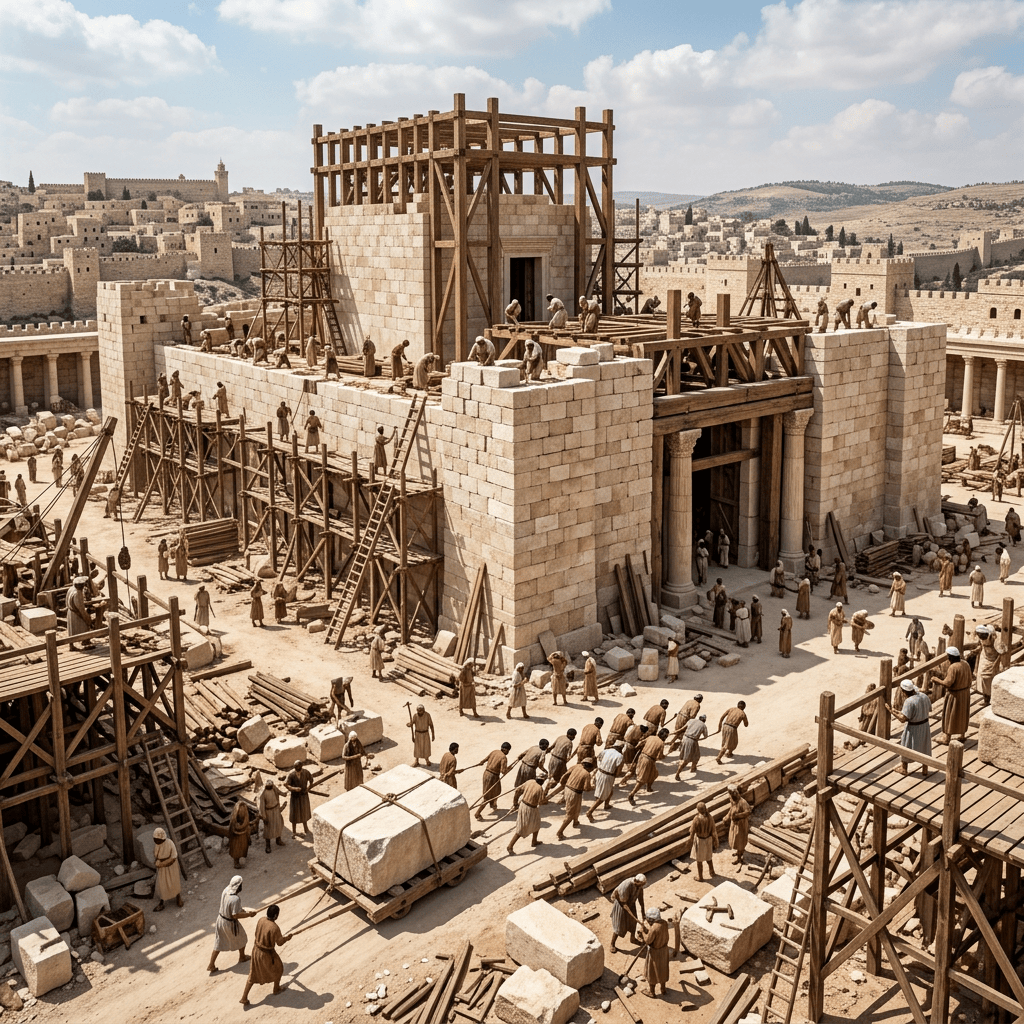
1 Kings 5:5-6 “I intend to build a house for the name of the Lord my God, as the Lord said to David my father, ‘Your son, whom I will set on your throne in your place, shall build the house for my name.’ Now therefore command that cedars of Lebanon be cut for me. And my servants will join your servants, and I will pay you for your servants such wages as you set, for you know that there is no one among us who knows how to cut timber like the Sidonians.”
When Isaiah saw a vision of God in the temple, included in that vision were the seraphim, a type of angel. We are told that these angels were saying, “Holy, holy, holy is the Lord of hosts; the whole earth is full of his glory!” (Isaiah 6:3). So here we have a heavenly perspective on the physical reality of this earth. The world that our Lord created shows His fingerprints in every aspect. As a result, every physical thing in this universe can be pointed to as either a simile or a metaphor of a spiritual reality. The Bible is filled with such examples.
And so Jesus is likened to such things as a door, a lamb, a shepherd, and a light. The Holy Spirit is likened to such things as oil, a dove, the wind, and a fire. The Father is likened to a husband, a father, a king, and a judge. Everywhere we look we can see such things, if we only have eyes to see them.
The Bible also uses metaphors to describe the spiritual condition of people. Thus, Herod is likened to a fox and the Pharisees to whitewashed tombs and the blind leading the blind. The church is likened to both a body and a building, and specifically, a spiritual temple. Which brings us to the passage above from 1 Kings which speaks of Solomon’s preparations for building the temple in Jerusalem. Everywhere we look in the Old Testament we see shadows of the spiritual realities of the New Testament. We see types of Christ, types of Satan, types of the church, etc. So what can we make of the types in the passage above?
What we have in these verses is an excerpt from a conversation between King Solomon, who was the son of David, and Hiram, another king who had come alongside Solomon to help him in this building project. The specific request that Solomon had given Hiram was that he bring him cedars from the great forests of Lebanon. He was to cut them down, and then in verse of chapter 5 Hiram said this: “My servants shall bring it down to the sea from Lebanon, and I will make it into rafts to go by sea to the place you direct. And I will have them broken up there, and you shall receive it.”
Concurrently, Solomon’s servants “quarried out great, costly stones in order to lay the foundation of the house with dressed stones. So Solomon’s builders and Hiram’s builders and the men of Gebal did the cutting and prepared the timber and the stone to build the house.”
So, are there any shadows here for us to consider? Well, one that is rather clear-cut is that in Ephesians 2 we are told this about the spiritual temple of God: “So then you are no longer strangers and aliens, but you are fellow citizens with the saints and members of the household of God, built on the foundation of the apostles and prophets, Christ Jesus himself being the cornerstone,in whom the whole structure, being joined together, grows into a holy temple in the Lord. In him you also are being built together into a dwelling place for God by the Spirit.”
So here we see that the physical foundation stones of Solomon’s temple are likened to the apostles and prophets in Ephesians 2. As such, it is pointing to the teachings and writings of these men, with Jesus, Himself, being the great cornerstone. We have a picture here of the absolutely critical nature of the Word of God in our lives individually, and in the church, collectively. Jesus said as much in His Sermon on the Mount when He said, “Everyone then who hears these words of mine and does them will be like a wise man who built his house on the rock. And the rain fell, and the floods came, and the winds blew and beat on that house, but it did not fall, because it had been founded on the rock. And everyone who hears these words of mine and does not do them will be like a foolish man who built his house on the sand. And the rain fell, and the floods came, and the winds blew and beat against that house, and it fell, and great was the fall of it” (Matthew 7:24-27).
But then let’s think about these cedars of Lebanon, some of the other building materials of Solomon’s temple. Interestingly, Jesus, likewise, used a metaphor for trees when He said, “Beware of false prophets, who come to you in sheep’s clothing but inwardly are ravenous wolves. You will recognize them by their fruits. Are grapes gathered from thornbushes, or figs from thistles? So, every healthy tree bears good fruit, but the diseased tree bears bad fruit. A healthy tree cannot bear bad fruit, nor can a diseased tree bear good fruit. Every tree that does not bear good fruit is cut down and thrown into the fire. Thus you will recognize them by their fruits” (Matthew 7:15-20). So here Jesus likens people to trees. This same metaphor is used many other places in Scripture to refer to people. Interestingly, In Ezekiel 31 there is a very specific reference to the cedars of Lebanon. In this prophesy, which was spoken to Egypt’s pharaoh, it is said, “Behold, Assyria was a cedar in Lebanon, with beautiful branches and forest shade, and of towering height, its top among the clouds.” It goes on to describe the stateliness and great beauty of these trees. Interestingly, the word “cedar” comes from a root that means to be firm or strong. But what Ezekiel is pointing to in this prophecy was that the nation of Assyria had become very proud. They were “lifted up” in their own minds and saw themselves as imposing and wonderful as these beautiful trees. But then God says to them, “Because it towered high and set its top among the clouds, and its heart was proud of its height, I will give it into the hand of a mighty one of the nations. He shall surely deal with it as its wickedness deserves. I have cast it out. Foreigners, the most ruthless of nations, have cut it down and left it. On the mountains and in all the valleys its branches have fallen, and its boughs have been broken in all the ravines of the land, and all the peoples of the earth have gone away from its shadow and left it. On its fallen trunk dwell all the birds of the heavens, and on its branches are all the beasts of the field. All this is in order that no trees by the waters may grow to towering height or set their tops among the clouds, and that no trees that drink water may reach up to them in height. For they are all given over to death, to the world below, among the children of man, with those who go down to the pit.”
So back to 1 Kings 5. It’s so interesting that it is cedar trees that are being used for the materials of the temple, and that believers are likened, in a sense, to these trees, in that believers are those described in Ephesians 2 who are being “built on the foundation of the apostles and prophets . . . (and) grows into a holy temple in the Lord. In him you also are being built together into a dwelling place for God by the Spirit.” But note that the cedar trees of Solomon’s temple first had to be cut down by Hiram, transported by Hiram across the sea to Solomon, where Solomon would “receive” them (1 Kings 5:9). That word “receive” here was translated from a Hebrew word that means “to lift, or to raise up.”
What rich metaphors we can see here. You see, just as the cedars of Lebanon can point to people who are very proud, any person who is to ever be included in the temple of God begins in a condition of pride. That’s the natural condition of everyone. It’s the clearest evidence of our sin. But we must be “cut down,” i.e., humbled, if we are ever to enter the kingdom of God. That humbling is done by a great king, as the Holy Spirit does His work in our hearts. In fact, it’s more than a humbling that must take place. For just as the cutting process in Lebanon brought death to those trees, every person who enters the kingdom of God must first die. It’s as we identify with the death of Christ, which satisfied the Father as the atonement for our sins, that this occurs. And just as Hiram took those trees down into the water and Solomon raised them up, so baptism points to our death to sin and resurrection with Christ when we believe. It’s as Paul told Timothy, “If we have died with him, we will also live with him” (2 Timothy 2:11). In summary, we must be cut down to be built up, just like those cedars of Lebanon.
So, does this all make sense to you? Have you ever realized that you are a sinner and been humbled as a result? Have you ever been cut down in your pride, admitted you are a sinner, and turned for new life to Christ? Have you been raised to the new life He offers you? You see, that’s the message of the gospel, the foundation of the temple of God. And it is that very foundation of the Word of God upon which every person who is a part of God’s holy temple is built up in Him.
Yes, just as the seraphim exclaimed in Isaiah’s vision, “the whole earth is full of his glory.” Have you been cut down to be built up into this holy temple? For if so, then this glory which fills the whole earth will also fill you.
Praise the Lord!


Leave a Reply