1 Samuel 24:3-4 “Now David and his men were sitting in the innermost parts of the cave. And the men of David said to him, ‘Here is the day of which the Lord said to you, “Behold, I will give your enemy into your hand, and you shall do to him as it shall seem good to you.”’”
Have you ever thought about how the rulers of this world deal with their enemies? I’ve been reading a book recently about World War II. It is sobering to consider the ruthlessness of men like Hitler and Stalin in their efforts to rule the world. At Hitler’s direction, over six million Jews, disabled persons, and homosexuals were murdered. Then there were millions of soldiers and civilians killed in the war itself. Stalin murdered millions of his own countrymen as he took control over the Soviet Union with his iron fist. That’s how the rulers of this world so often operate. They control by force. You will obey them, or else. It’s a horrible state of affairs, but it’s always been that way.
We see another example of this in the book of 1 Samuel as we read about how King Saul ruled his kingdom. To cross him meant certain death, as the priests who aided David, whom Saul was pursuing, found out. He murdered 85 of them (1 Samuel 22:18). Saul saw David as a rival and a threat to his power, for David was the one whom God had anointed to take Saul’s place – in God’s own time. David knew this, and he submitted to the providence and will of God in his ascent to the throne. But he wouldn’t have had to. In the passage above we find David hiding in a cave at Engedi. Saul, along with 3,000 of his elite soldiers, were searching for him high and low. Then, in the providence of God, Saul enters the very cave where David and his men are hiding. Some versions of the Bible say that he did this to “cover his feet,” interpreted by some as meaning “to relieve himself,” but by others “to sleep.” I favor the latter interpretation, because it makes much more sense. In any event, when David’s men realize that Saul was, unwittingly, in a totally defenseless and vulnerable position, they urge David to kill him. It seemed to them an opportunity that God was giving him to be rid of his enemy once and for all.
But David refused. Instead, he just cut off a corner of Saul’s robe, but even that injured David’s conscience. He knew that killing Saul was not God’s will for him, and he had never done anything more than this against Saul. After Saul left the cave, David called out to him with these words: “Why do you listen to the words of men who say, ‘Behold, David seeks your harm’? Behold, this day your eyes have seen how the Lord gave you today into my hand in the cave. And some told me to kill you, but I spared you. I said, ‘I will not put out my hand against my lord, for he is the Lord’s anointed.’ See, my father, see the corner of your robe in my hand. For by the fact that I cut off the corner of your robe and did not kill you, you may know and see that there is no wrong or treason in my hands. I have not sinned against you, though you hunt my life to take it. May the Lord judge between me and you, may the Lord avenge me against you, but my hand shall not be against you.” At this Saul is cut to the heart. The Bible says, “And Saul lifted up his voice and wept. He said to David, ‘You are more righteous than I, for you have repaid me good, whereas I have repaid you evil. And you have declared this day how you have dealt well with me, in that you did not kill me when the Lord put me into your hands. For if a man finds his enemy, will he let him go away safe? So may the Lord reward you with good for what you have done to me this day. And now, behold, I know that you shall surely be king, and that the kingdom of Israel shall be established in your hand.’”
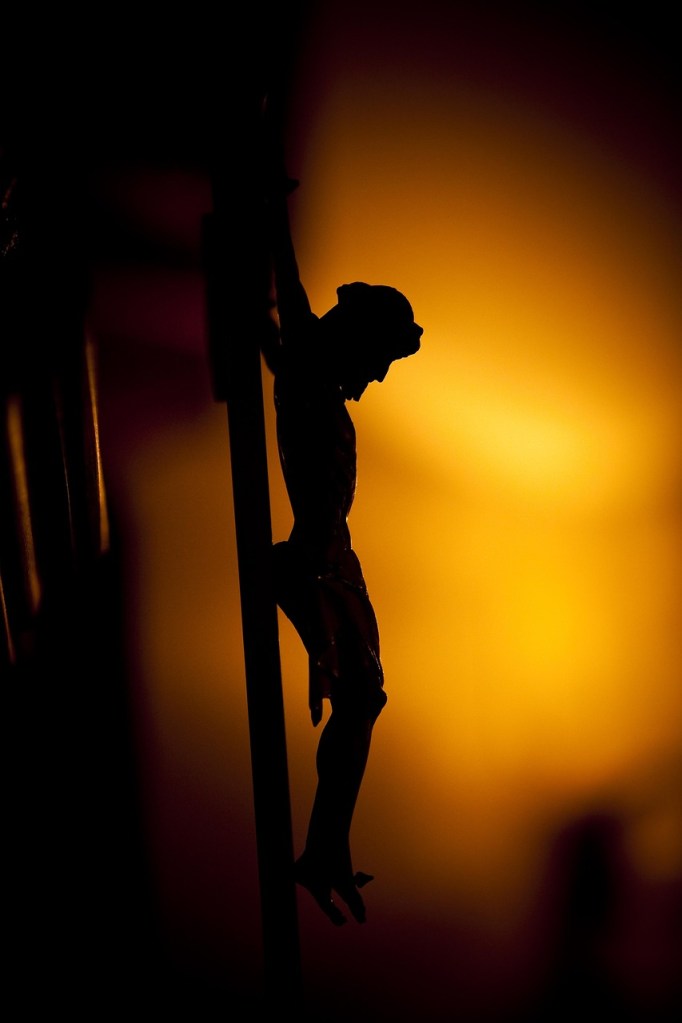
As we read this, we see the contrast between God’s anointed king, David, and God’s rejected king, Saul. Saul’s way was the natural way, the world’s way, the typical way that the kings of the earth do what they do. David, on the other hand, had returned good for evil and waited for God’s timing to secure his kingdom. He didn’t take it by force, though he surely could have. It is in this that we have a wonderful shadow of God’s anointed King of kings, the Lord Jesus Christ. Here is One Who was able to say “All authority in heaven and on earth has been given to me” (Matthew 28:18). His disciples had seen him raise the dead, heal the sick, cast out demons, and calm the sea. They anticipated that with such power he would establish his kingdom by force – and surely, He could have. He acknowledged as much in these words to Peter when Peter tried to defend Him with a sword when Jesus was accosted by a crowd to arrest Him just before He would go to the cross: “Do you think that I cannot appeal to my Father, and he will at once send me more than twelve legions of angels?” (Matthew 26:53). But unlike the kings of this earth, unlike what his own disciples anticipated, unlike the type of Messiah that the Jews expected as they threw their cloaks on the road before Him and waved palm branches to salute him as the King of the Jews, Jesus did not establish His kingdom by force. Rather than rule with an iron fist, which He could have done, with a power that no other ruler has remotely ever known, this king draws us to himself in love. He seeks those who will willingly humble themselves at his feet. That’s why Paul asks us all the following question, in his words recorded in Romans 2:4: “Or do you presume on the riches of his kindness and forbearance and patience, not knowing that God’s kindness is meant to lead you to repentance?”
Each of us begins life as a Saul. We see ourselves on the throne of our own life. Whether we fully realize it or not, we live our life with a “mind that is set on the flesh (that) is hostile to God, for it does not submit to God’s law; indeed, it cannot” (Romans 8:7). Although the Lord is the King of heaven and earth, our natural bent is to resist His rule over our lives. We want what we want, not what He wants.
So, what would any other ruler with absolute authority do in such a case? What would an earthly king do to those who refused to obey his commands? I think we know the answer. But what does the Lord do? How does the One who alone is “worthy . . . to receive glory and honor and power” (Revelation 4:11) respond to our rebellion? He waits patiently for us to open our eyes to the Truth. He loves us. He meets our every need. And He calls us with the invitation to come unto Him that He might give us rest (Matthew 11:28). He calls us to submit with the incredible words, “Take my yoke upon you, and learn of me; for I am meek and lowly in heart: and ye shall find rest unto your souls” (Matthew 11: 29). He is One Who lays down His life so that our rebellion can be forgiven for all eternity.
May God help us to submit to the King of kings while we still have time, a king that waits for us to realize that He is God’s anointed One. It is King Jesus alone Who graciously waits for us like no other king that has ever lived.
 To Encourage You
Leave a comment